Loading
Loading
Lazy senior developer mode for AI agents that pushes YAGNI, standard-library-first, native-first, and minimal-code behavior through skills, commands, rules, and lifecycle hooks.
written by ForgeCat
Lazy senior developer mode for AI agents, with YAGNI, standard-library-first, native-first, and minimal-code guidance packaged as skills, commands, rules, and lifecycle hooks.
npx forgecat install @forgecat/dietrichgebert_ponytail
skillskillskillponytail: comments into a shortcut debt ledger. skillskillcommandcommandcommandponytail: comments into a ledger. commandcommand| Field | Value |
|---|---|
| Author | Dietrich Gebert |
| Original repository | https://github.com/DietrichGebert/ponytail |
| Version | 0.1.6 |
| Original commit | 1c420ad2f306b2a096dd1e7c1b8c5ebbb4cdf3d4 |
| License | MIT |
| Source platform | Multi-platform: Claude Code plugin, Codex plugin, Cursor rule, OpenCode plugin, Gemini extension, pi extension, and generic AGENTS.md/skills adapters |
| Platform | Status |
|---|---|
| Claude Code | Tested |
| Cursor | Partial |
| Codex | Tested |
written by original source

He says nothing. He writes one line. It works.




80-94% less code · 3-6× faster · 47-77% cheaper
Median of 10 runs across Haiku, Sonnet, and Opus. Reproduce it yourself.
You know him. Long ponytail. Oval glasses. Has been at the company longer than the version control. You show him fifty lines; he looks at them, says nothing, and replaces them with one.
Ponytail puts him inside your AI agent.
You ask for a date picker. Your agent installs flatpickr, writes a wrapper component, adds a stylesheet, and starts a discussion about timezones.
With ponytail:
<!-- ponytail: browser has one -->
<input type="date">
More survivors in examples/.
Five everyday tasks (email validator, debounce, CSV sum, countdown timer, rate limiter), three models, three arms: no skill, the caveman skill, and ponytail. Ten runs per cell, median reported.
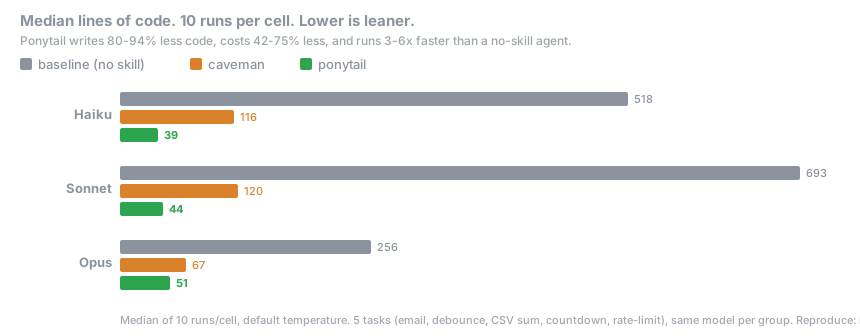
80-94% less code, 47-77% less cost, and 3-6× faster than a no-skill agent, on every model. Every shortcut ponytail takes is marked in the code with a ponytail: comment naming its upgrade path. Reproduce it yourself: npx promptfoo eval -c benchmarks/promptfooconfig.yaml. Method and raw numbers: benchmarks/. Production-grade tasks, where an unconstrained agent bloats far more, are written up in benchmarks/results/.
Before writing code, the agent stops at the first rung that holds:
1. Does this need to exist?   → no: skip it (YAGNI)
2. Stdlib does it?            → use it
3. Native platform feature?   → use it
4. Installed dependency?      → use it
5. One line?                  → one line
6. Only then: the minimum that works
Lazy, not negligent: trust-boundary validation, data-loss handling, security, and accessibility are never on the chopping block.
The most effort ponytail will ever ask of you:
/plugin marketplace add DietrichGebert/ponytail
/plugin install ponytail@ponytail
codex plugin marketplace add DietrichGebert/ponytail
codex
Open /plugins, select the Ponytail marketplace, and install Ponytail. Then
open /hooks, review and trust its two lifecycle hooks, and start a new thread.
pi install git:github.com/DietrichGebert/ponytail
Run OpenCode from a checkout of this repo (the plugin reuses its hooks/ and skills/), and add to opencode.json:
{ "plugin": ["./.opencode/plugins/ponytail.mjs"] }
Injects the ruleset every turn at the active level; adds the /ponytail commands (see Commands). OpenCode also auto-loads this repo's AGENTS.md, so the rules hold even without the plugin. The plugin adds the lite/full/ultra/off levels.
gemini extensions install https://github.com/DietrichGebert/ponytail
Loads the ruleset as always-on context every session and registers the /ponytail commands; the skills/ ship too, activated when a task needs them.
That was it. He'd be proud. He won't say it.
Active every session, with a handful of commands (see Commands). /ponytail ultra exists for when the codebase has wronged you personally. Startup and mode-change text shows the current mode.
Cursor, Windsurf, Cline, Copilot, Aider, Kiro: copy the matching rules file from this repo (.cursor/rules/, .windsurf/rules/, .clinerules/, .github/copilot-instructions.md, AGENTS.md, .kiro/steering/).
Kiro: copy .kiro/steering/ponytail.md to ~/.kiro/steering/ (global) or .kiro/steering/ in your project.
GitHub Copilot CLI: it already reads AGENTS.md and .github/copilot-instructions.md in a project, or copy the rules into ~/.copilot/copilot-instructions.md to run ponytail in every project.
Antigravity and VS Code with the Codex extension: both read AGENTS.md, which this repo ships, so it works from the repo root with no setup (~/.codex/AGENTS.md makes Codex global, .agents/rules/ makes it an always-on rule in Antigravity).
Which files map to which agent: Agent portability.
| Command | What it does |
|---|---|
/ponytail [lite | full | ultra | off] | Set the intensity, or turn it off. No argument reports the current level. |
/ponytail-review | Review the current diff for over-engineering, hands back a delete-list. |
/ponytail-audit | Audit the whole repo for over-engineering, not just the diff. |
/ponytail-debt | Harvest the ponytail: shortcuts you've deferred into a ledger, so "later" doesn't become "never". |
/ponytail-help | Quick reference for the commands above. |
Commands need a skill-capable host (Claude Code, Codex, OpenCode, Gemini, pi). In Codex they're skills, invoke with @ (@ponytail-review). The instruction-only adapters (Cursor, Windsurf, Cline, Copilot, Kiro, Antigravity) load the always-on ruleset without the commands.
When changing the compact rule text, keep the agent copies aligned:
node scripts/check-rule-copies.js
Does it need a config file? No.
What if I really need the 120-line cache class? You don't. Insist anyway and he'll build it. Slowly. Correctly. While looking at you.
Does it scale? The code you never wrote scales infinitely. Zero bugs, zero CVEs, 100% uptime since forever.
Why "ponytail"? You know exactly why.
MIT. The shortest license that works.

forgecat
View CreatorNone
Evaluated 6/15/2026
 ForgeCat